
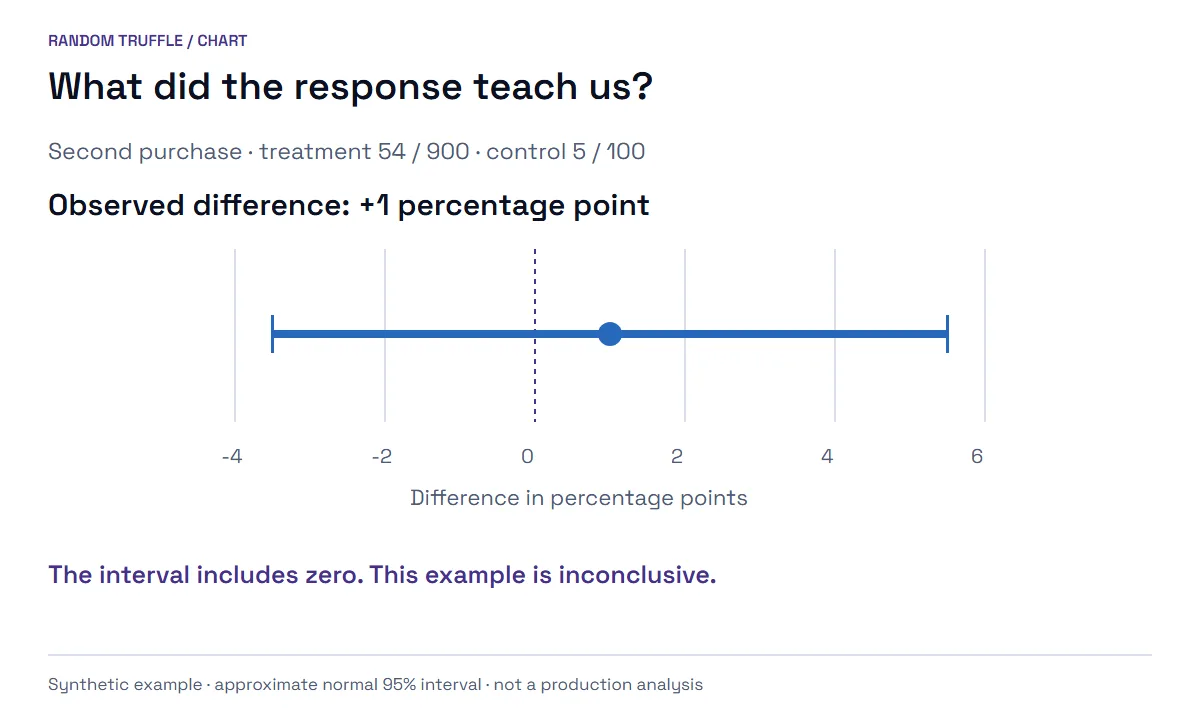
What would have happened without the campaign?
Define a credible comparison, inspect uncertainty and distinguish incremental effect from attribution credit.
Imagine you own a pizza shop. Business is good, but you want it to be better. So, you hire a teenager to hand out "Free Soda with Slice" coupons.
At the end of the day, the teenager comes back with empty hands and a grin. "I gave away all 500 coupons!" he says. "And look! The register is full of them!"
You pay him a bonus. He is a marketing genius.
But the next day, you watch him work. You see him standing inside the pizza shop, handing coupons to people who are already standing in line to order.
This is the state of modern digital marketing attribution.
We are paying billions of dollars to ad platforms that claim credit for customers who were going to buy from us anyway. We are mistaking Activity for Incrementality.
And for the CMO, this leads to the most terrifying question in the boardroom: "Is our marketing actually working, or are we just riding the wave?"
The "Last-Click" Hallucination
For the last decade, we have been addicted to "Last-Click Attribution." If a user clicked a Google Ad and then bought a pair of shoes, Google claimed 100% of the credit.
This works fine for simple e-commerce. But what if you are a CPG (Consumer Packaged Goods) brand?
You spend $5M on YouTube ads for your new organic shampoo.
A user sees the ad, likes the vibe, and three days later buys the shampoo at Walmart.
The Result: Google Ads reports 0 conversions (because it can't see the Walmart register). Walmart reports a sale, but doesn't know why.
Your dashboard says the campaign failed. Your sales data says revenue is up. The truth is lost in the gap.
This is why Random Truffle is obsessed with moving enterprises from Attribution (Who gets the credit?) to Incrementality (What actually caused the lift?).
Enter the Geo-Experiment (The Truth Serum)
Since we can no longer track individuals across the internet (thanks to privacy laws and cookie death), we have to stop tracking people and start tracking places.
This is called a Geo-Experiment. It is the gold standard of Causal Inference.
Here is how it works in plain English:
The Setup: You take the United States and slice it into small geographic regions (Designated Market Areas or DMAs).
The Split: You use an algorithm to find two groups of regions that behave almost identically. Let's say "Group A" (Kansas City, Austin, Denver) and "Group B" (St. Louis, San Antonio, Phoenix). Their sales trends usually mirror each other perfectly.
The Intervention: You keep running your ads in Group A (The Treatment). You turn off your ads in Group B (The Control).
The Analysis: After 4 weeks, you look at the sales data. If Group A sales stayed flat while Group B sales tanked, your marketing works. If both groups stayed the same... congratulations, you just saved millions of dollars on useless ads.
Estimate the intervention's effect using a design and analysis that account for baseline differences, timing and uncertainty. A raw difference between regions is not sufficient by itself.
Easy to Say, "Nightmare" to Execute
If Geo-Testing is the holy grail, why isn't everyone doing it?
Because doing it manually is an operational nightmare.
Statistical Complexity: How do you select the regions? If you pick New York as a "Control" but Los Angeles as "Treatment," your data is garbage because those cities behave differently. You need Python libraries and cointegration tests just to pick the cities.
Ad Ops Chaos: Try telling your media agency to "suppress ads in these 47 specific zip codes across Meta, YouTube, and The Trade Desk for exactly 21 days." They will mess it up. They always do. Leakage happens.
Data Latency: In CPG, you often don't get sales data from retailers for weeks. By the time you analyze the test, the quarter is over.
Most marketing teams try a geo-test once, drown in spreadsheets, get inconclusive results, and go back to trusting the "Last Click" dashboard because it's easier.
Stop Guessing, Start Knowing
Marketing without incrementality testing is just vanity. It's the teenager handing out coupons to the people already in line.
It feels good. The metrics look great. The ROAS is high. But the business isn't growing.
To truly drive growth, you need the courage to ask: "What would have happened if we did nothing?"
The answer might hurt. It might show that your favorite campaign is worthless. But that pain is useful. That pain saves you budget. That pain allows you to double down on the things that actually move the needle.
Let's find the truth.
Four agents. One shared understanding.
Explore how Nexus, Aura, Prism and Radian turn a question into evidence, creative and action.
Meet the agents →Keep exploring.
 Measurement / 4 MIN READ
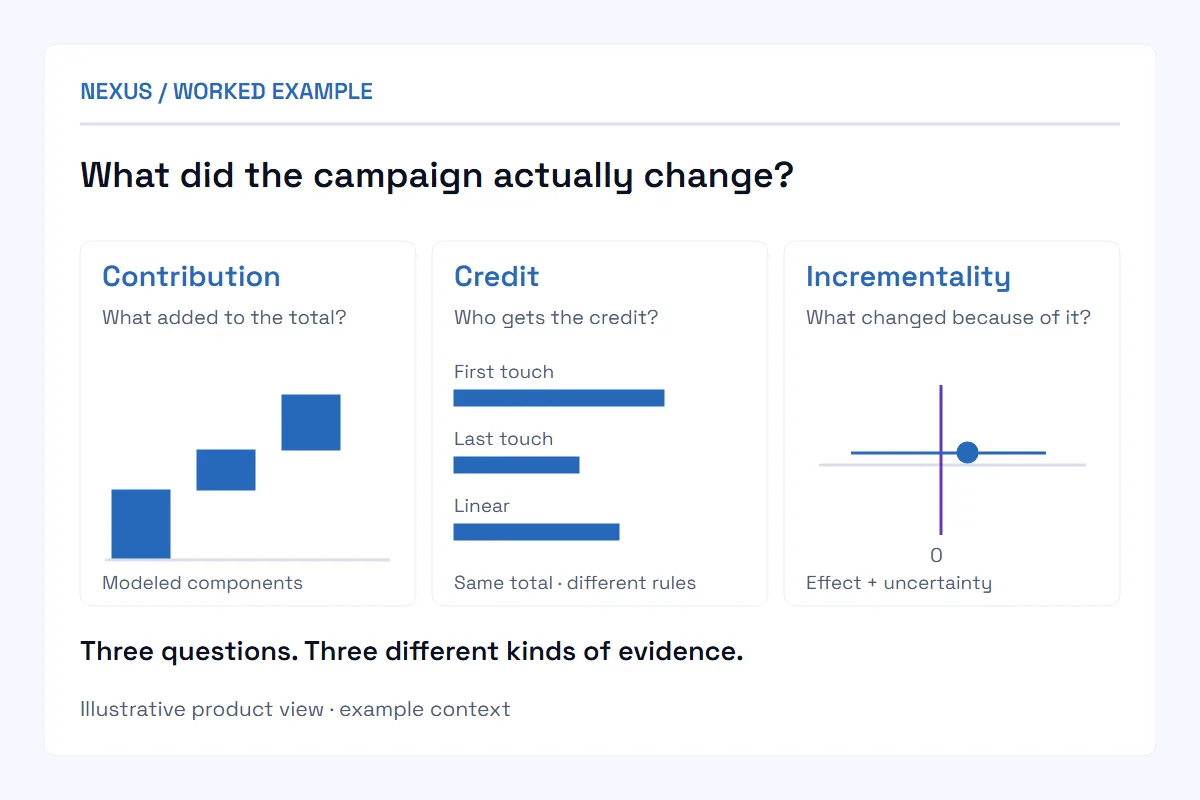
Contribution, credit and incrementality are different questions.
Why three useful measurement views should not collapse into a single performance number.
Read the field note →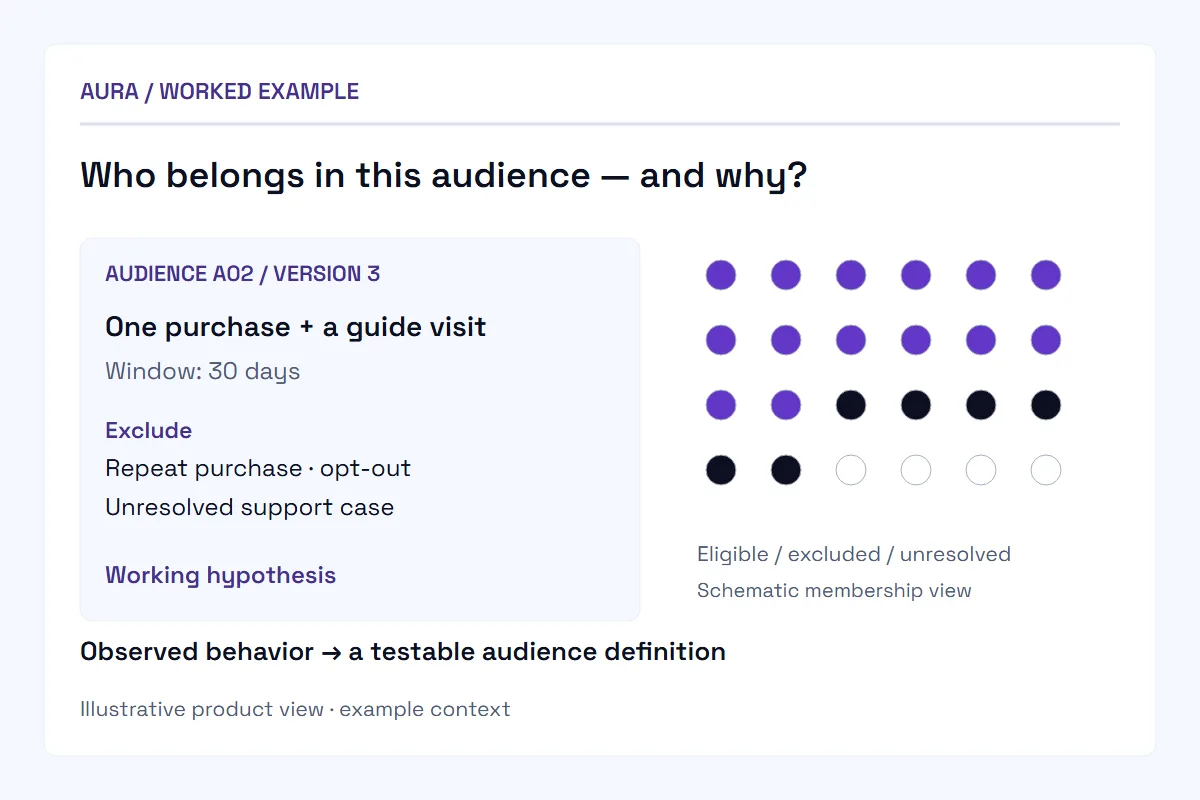 Audience intelligence / 4 MIN READ
An audience is a hypothesis, not a label.
A practical way to connect behavior, context and the next question—without pretending a segment explains a person.
Read the field note →