
From a useful prompt to a working process
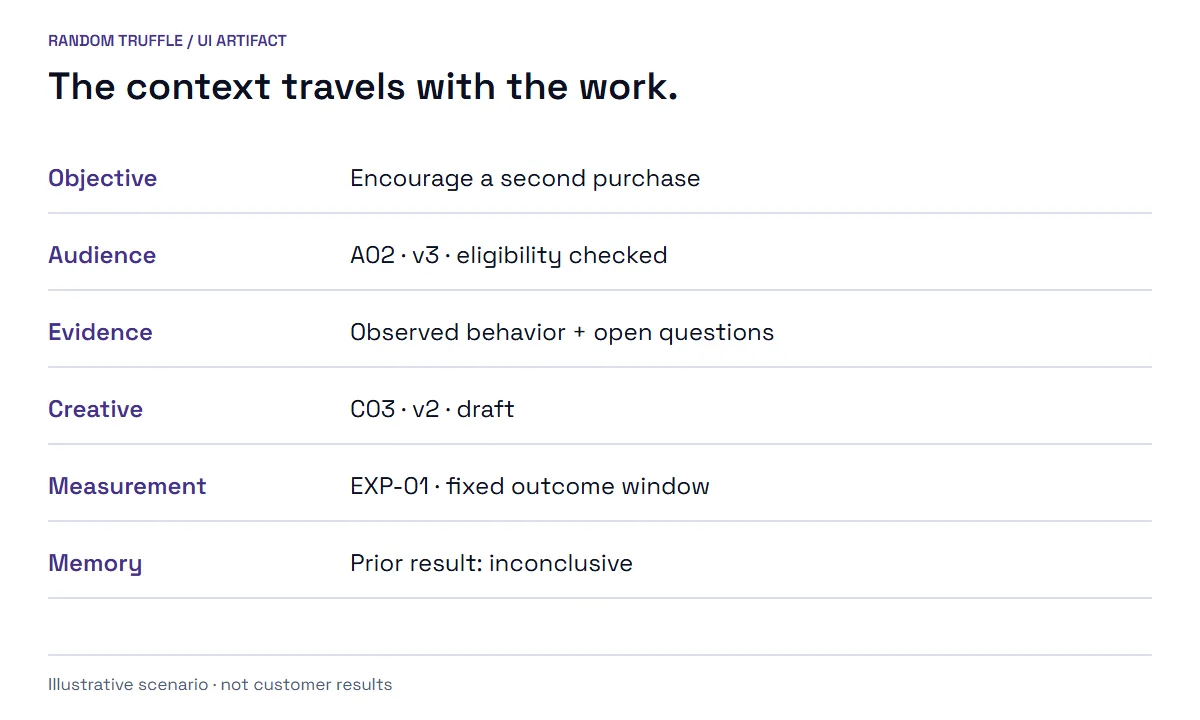
Define what an agent needs to know, which actions it may take and how its work will be reviewed.
If you've spent the last year feeling like you're trapped in a never-ending chat window, you aren't alone.
We've all been there. You open a generative AI tool, you type a prompt, it spits out a decent email subject line or a Python script, and you feel a momentary rush of productivity. But then, five minutes later, you're back to doing the actual work: copying, pasting, formatting, logging into the CRM, clicking "send," and updating the spreadsheet.
We have been sold the dream of Artificial Intelligence, but what we've mostly been using is Artificial Assistance.
At Random Truffle, we spend a lot of time thinking about the delta between "helpful" and "transformational." And right now, we are standing on the precipice of a shift that makes the initial hype around generative text look like a warm-up act.
We are moving from Generative AI (creating content) to Agentic AI (executing actions). We are moving from tools you talk to, to systems with a defined role, access and operating limits.
This isn't just automation. Automation is a script that follows rules. This is intelligence that follows intent.
Let's re-engineer how we think about your marketing workforce.
The End of "Chatting," The Beginning of "Hiring"
The mental model for AI in marketing has historically been "The Intern." You give it a task, it does a mediocre job, you fix it, and you move on.
The new model is "The Agent."
State-of-the-art developments in autonomous AI are allowing us to move past the chat interface entirely. We aren't just spinning up instances of a model; we are creating distinct, persistent identities—let's call them "Prism" or "Nexus" for the sake of this conversation ;)
These aren't just windows in a browser. Advanced agents can now be given their own user accounts on a machine. They have a "job description." You can log them in, assign a goal (e.g., "Find 50 qualified leads in the fintech sector, verify their emails, and draft personalized outreach based on their recent news"), and define which actions it may take and how its work will be reviewed.
Within those limits, the agent works through the task. It isn't just generating text; it's using a browser. It's switching tabs. It's logging data into a spreadsheet. It's navigating complex UI barriers that would baffle a simple script.
The Marketer as Orchestrator
So, if the AI is doing the clicking, the searching, and the sending, what is left for the marketer?
Everything that actually matters.
The bottleneck in marketing is shifting. It used to be execution—there were only so many hours in the day to write emails or analyze data rows. Now, the bottleneck is direction.
Marketers are transitioning into Product Managers for their AI workforce. The primary skill of the modern marketer isn't "writing copy" or "managing bids"; it is the ability to clearly define what needs to be done and why.
Think of it as the difference between a cook and a chef. The cook chops the onions (execution). The chef designs the menu and ensures the kitchen flow is optimized (orchestration).
In this agentic future, "Task Paralysis" dissolves. Previously, if you wanted to fix a bug on your landing page or call a venue to book an event, you had to stop your strategic work to do the manual labor. Now, agents can connect to voice APIs to make calls, or access codebases to propose fixes for review.
Your job shifts from "Creator" to "Auditor." You spend less time creating the initial output and more time reviewing the logs of what your agents did, refining their instructions, and ensuring their output aligns with your brand voice.
State-of-the-Art: Self-Healing and Cross-Tab Agency
How is this different from the automation scripts we've had for a decade? If you've ever built a Zapier workflow, you know that if one API changes or a comma is out of place, the whole thing explodes.
The new class of AI agents possesses a capability that engineers call "Self-Healing."
If an advanced agent encounters a bug while trying to execute a marketing task—say, a button moved on a website it was researching—it doesn't just crash. It can identify the error, propose a fix, and retry the task within the access it has been given, with each change logged for review.
Furthermore, these agents possess "Cross-Tab" agency. They aren't siloed. They mimic human workflow. They can: Open a browser to research a competitor's pricing. Switch to a terminal to run a data analysis script. Open a spreadsheet to log the findings. Jump into Slack to ping you a summary.
This is the holy grail of productivity: software that understands context across different applications.
"Skills" Are the New SOPs
This brings us to a critical realization about intellectual property.
For the last two years, everyone has been obsessed with "Prompt Engineering." But prompts are fleeting. In the agentic world, we don't train AI with prompts; we train them with Skills.
A "Skill" is essentially a documented Standard Operating Procedure (SOP)—often written in simple markdown—that teaches an agent how to do a specific job. How do we scrape leads without violating privacy policies? How do we tone-check an email for our specific brand voice? How do we triangulate data between three different dashboards?
By documenting these workflows, you are building a knowledge base that still needs owners, version control and testing as the business changes. The agent references these Skills to execute tasks more consistently.
This is where your value lives. The generic AI model is a commodity. Your proprietary "Skills"—your unique way of doing marketing—are the competitive moat. At Random Truffle, we view this library of Skills as the new gold standard for enterprise value. It's not about the software you buy; it's about the intelligence you encode into it.
The Enterprise Reality Check: Security vs. Autonomy
Now, for the cold water.
If you are reading this and thinking, "Great, I'll download an open-source agent and let it run wild on my company laptop," please pause.
There is a massive trade-off currently playing out in the AI space between Usefulness and Security.
To make an agent truly useful—to give it the power to send emails, access bank accounts, write code, or manage ad spend—you effectively have to hand it the keys to the castle. You have to lower the drawbridge on standard security protocols.
In the open-source world, this is currently a security nightmare. It is a hacker's feast. If an agent has permission to "do anything," it can be tricked into doing "bad things."
This is why Random Truffle approaches this space with an enterprise-first mindset. We believe that autonomy cannot exist without architecture.
We aren't just throwing agents at problems; we are building sandboxed, secure environments where these agents can operate safely. We are building the governance layer that allows an enterprise to spin up an "Outbound Sales Department" or a "Deep Research Unit" without risking data sovereignty or compliance.
Deep Research: The First Killer App
While security protocols mature, there is one area where agents are already useful: Deep Research.
If you want to launch a new product, a human might spend a week browsing Reddit forums, reading Amazon reviews, and skimming industry reports to understand customer pain points.
An agent can aggregate large volumes of data points, analyze sentiment, cross-reference pricing, and draft a strategic briefing document for review. Its sources and reasoning should remain visible so the team can inspect them.
This isn't about replacing intuition; it's about feeding your intuition with better ingredients.
Re-Engineering the Future
The shift from automation to intelligence is not a subtle upgrade. It is a fundamental rewriting of the marketing playbook.
For marketers, the advice is simple: Don't rush to install the latest experimental agent on your work device. Instead, focus on building your "soft assets." Build your audience. Refine your strategy. Document your SOPs.
When the technology matures—and when platforms like ours bridge the gap between "bleeding edge capability" and "enterprise security"—the winners won't be the ones who can write the best email. The winners will be the ones who have the best products and the clearest vision to feed into the machine.
At Random Truffle, we are building the infrastructure for that future. We are taking the chaos of the open AI ecosystem and re-engineering it into reliable, intelligent systems for the enterprise.
The future of marketing isn't about working harder. It's about building a machine that works for you.
Are you ready to be the architect?
Four agents. One shared understanding.
Explore how Nexus, Aura, Prism and Radian turn a question into evidence, creative and action.
Meet the agents →Keep exploring.
 AI & marketing / 8 MIN READ
Measuring your brand’s visibility in AI search
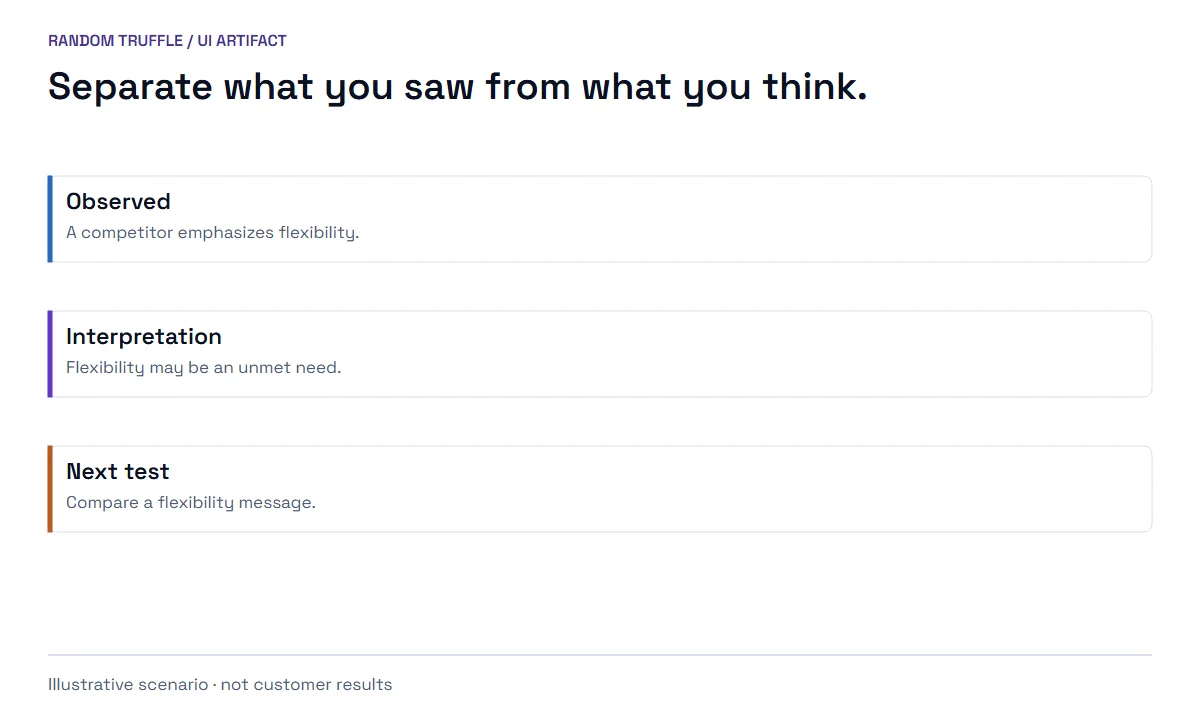
Build a repeatable set of buyer questions, inspect the sources cited and test whether clearer content changes the observed response.
Read the field note →AI & marketing / 4 MIN READGive agents a playbook they can use
Keep brand rules and working instructions in reusable skills, with clear versions, owners and review steps.
Read the field note →